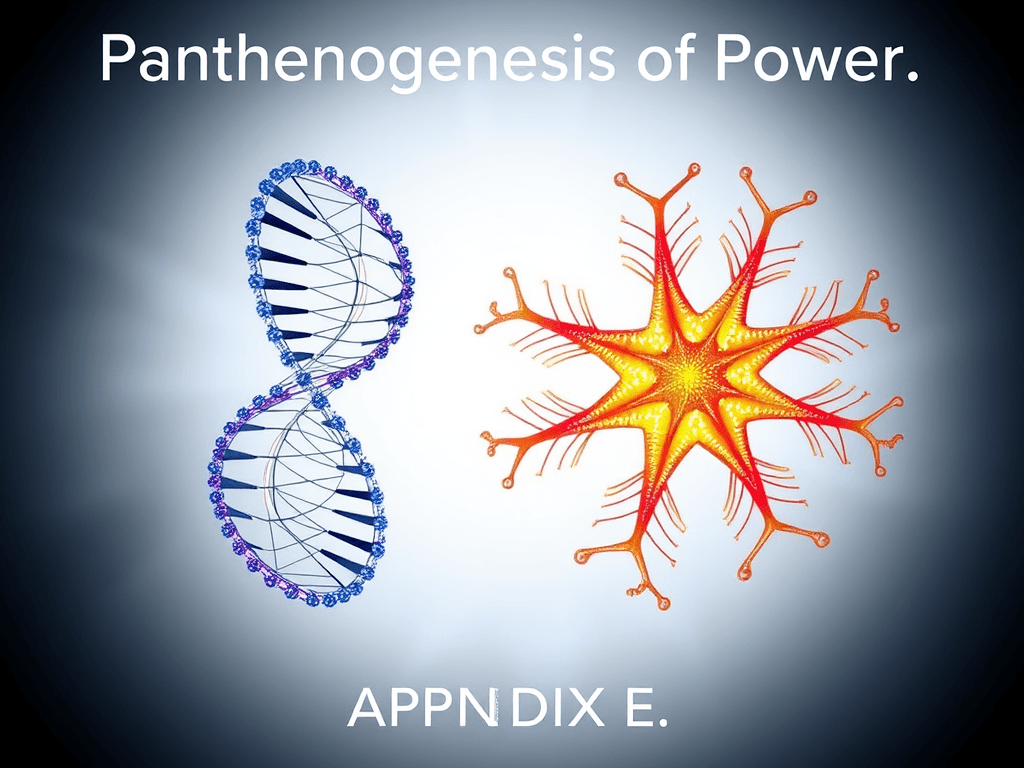
Unified Theory of the Panthenogenesis of Power
APPENDIX E
DIAGRAMS + GEOMETRIES
The unified theory relies on a set of recurring geometries — visual metaphors that make the architecture of power, mutuality, and system‑design legible. These diagrams are not illustrations; they are structural maps. Each one captures a pattern that appears across relationships, organizations, cultures, and civilizations.
Below are the core geometries, described in clean, diagram‑ready form.
1. THE DOUBLE HELIX MODEL
Two interdependent strands that stabilize each other
Structure:
Two parallel spirals twisting upward, connected by regular cross‑links.
Represents:
- Two limbs of a system that co‑evolve
- Distinct but interdependent functions
- Stability through reciprocal influence
Use Case:
Your ecosystem (Spotify + WordPress) is a double helix:
- One strand: identity expression
- The other: narrative articulation
- Cross‑links: daily rituals, playlists, posts, and meaning‑making
Key Insight:
A system becomes resilient when its limbs evolve in tandem.
2. THE STARFISH MODEL
Decentralized, regenerative, multi‑limb architecture
Structure:
A central node with five or more limbs radiating outward.
Each limb can function independently and regenerate if severed.
Represents:
- Distributed power
- Modular design
- Redundancy
- Regeneration
Use Case:
Non‑captive organizations, mutual‑aid networks, creative ecosystems.
Key Insight:
No single limb is the center.
The system survives loss because power is distributed.
3. THE BRAIDED RIVER MODEL
Multiple channels flowing toward a shared direction
Structure:
Several parallel streams that diverge and rejoin, forming a braided pattern.
Represents:
- Non‑linear progress
- Multiple valid pathways
- Adaptive coherence
- Systems that evolve without centralization
Use Case:
Creative processes, cultural evolution, civilizational change.
Key Insight:
Coherence does not require uniformity.
It requires shared direction.
4. THE ROLE‑COLLAPSE CASCADE
How captive systems fail when inherited roles break down
Structure:
A vertical stack of roles (e.g., Center → Enforcer → Peacekeeper → Absorber → Scapegoat).
Arrows show downward pressure.
When one role collapses, the next absorbs the load until the system implodes.
Represents:
- The fragility of hierarchical emotional economies
- How systems rely on sacrificial roles
- Why collapse is predictable
Use Case:
Families, workplaces, institutions, political movements.
Key Insight:
Captive systems collapse because they rely on roles, not structure.
5. THE MUTUALITY MATRIX
The architecture of non‑captive relational systems
Structure:
A 2×2 grid:
| Low Clarity | High Clarity | |
|---|---|---|
| Low Reciprocity | Captivity | Transaction |
| High Reciprocity | Enmeshment | Mutuality |
Represents:
- The four relational architectures
- Why mutuality requires both clarity and reciprocity
- How systems drift into captivity or enmeshment
Use Case:
Relationships, teams, communities.
Key Insight:
Mutuality is not kindness.
It is the intersection of clarity and reciprocity.
6. THE EMOTIONAL ECONOMY ENGINE
How systems generate stability through emotional currency
Structure:
A circular diagram with five nodes:
Fear → Shame → Obligation → Suppression → Compliance → (back to Fear)
Next to it, a parallel non‑captive loop:
Clarity → Choice → Reciprocity → Repair → Stability → (back to Clarity)
Represents:
- The emotional logic of captive vs. non‑captive systems
- Why threat‑based systems self‑perpetuate
- How capacity‑based systems generate stability
Use Case:
Families, workplaces, cultures, civilizations.
Key Insight:
Emotional economies are the engines of systems.
7. THE FIELD MAP
The invisible architecture created by relationships
Structure:
A cloud‑like shape containing:
- Norms
- Roles
- Expectations
- Emotional flows
- Power dynamics
- Narratives
Arrows show how each element influences the others.
Represents:
- The relational environment
- Why systems behave predictably
- How individuals are shaped by fields
Use Case:
Any system with more than one person.
Key Insight:
The field is the true unit of analysis.
8. THE REPAIR CYCLE
How non‑captive systems metabolize rupture
Structure:
A circular loop:
Rupture → Naming → Dialogue → Repair → Recalibration → Integration → (back to Rupture)
Represents:
- Repair as metabolism
- Conflict as information
- Stability through recalibration
Use Case:
Relationships, teams, communities, institutions.
Key Insight:
Repair is not crisis response.
It is maintenance.
9. THE PANTHENOGENESIS LOOP
The self‑generating system
Structure:
A figure‑eight (∞) loop with four nodes:
Stability → Evolution → Meaning → Boundary Integrity → (back to Stability)
A second loop overlays it:
Repair → Recalibration → Adaptation → Distributed Power → (back to Repair)
Together, they form a self‑renewing ecology.
Represents:
- Systems that generate themselves
- Architecture becoming environment
- Evolution becoming instinct
Use Case:
Civilizations, cultures, organizations, long‑term communities.
Key Insight:
A system becomes self‑generating when it no longer requires a stabilizer.
10. WHY THESE GEOMETRIES MATTER
These diagrams are not illustrations.
They are cognitive tools.
They help readers:
- see the architecture
- understand the patterns
- diagnose systems
- design alternatives
- recognize captivity
- build mutuality
- imagine panthenogenesis
They turn the invisible into the visible.
They turn the abstract into the structural.
They turn the theory into a map.


























 Survivor Literacy
What do you think?