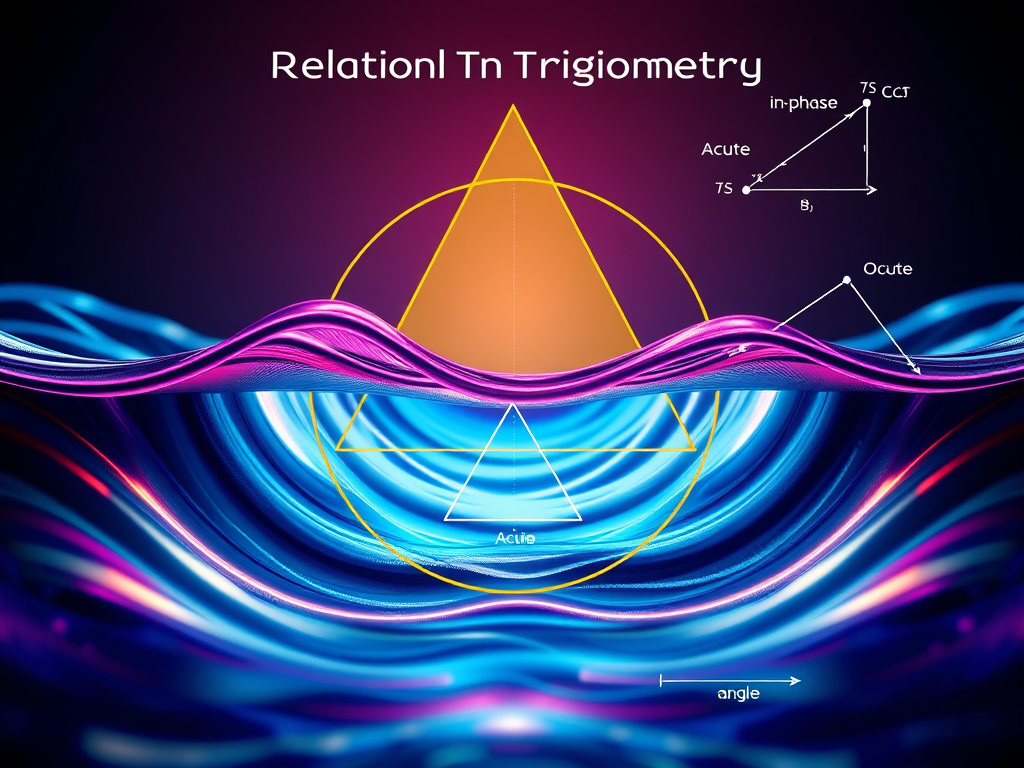
Relational Trigonometry
What Relational Trigonometry Adds That We Don’t Already Have
1. Phase Alignment (the big one)
Trigonometry is fundamentally about phase — how two waves relate in time.
Relational Trigonometry gives us:
- in‑phase resonance
- out‑of‑phase conflict
- phase drift
- phase lock
- phase inversion
This is something neither Geometry nor Calculus explicitly handles.
It’s the mathematics of synchronization.
This is huge for:
- relationships
- collaborations
- creative partnerships
- ecosystems with multiple pulses
- audience dynamics
It tells you not just how a field moves, but whether two movements can move together.
2. Relational Angles
Angles are about orientation.
Relational Trigonometry gives us:
- acute relational stance (approach)
- obtuse relational stance (avoidance)
- right‑angle relational stance (boundary)
- reflex angles (overextension)
This is not covered by Geometry (shape) or Algebra (combination).
It’s about how two relational vectors meet.
This is especially useful for:
- conflict analysis
- boundary work
- alignment diagnostics
- leadership dynamics
- identity positioning
It gives us a vocabulary for stance.
3. Relational Projection
Projection in trigonometry is about decomposing a vector into components.
Relationally, this becomes:
- how much of someone’s behavior is “theirs”
- how much is field‑induced
- how much is historical
- how much is contextual
This is a clean, mathematical way to talk about projection without psychology.
It’s a way to quantify:
- misalignment
- over‑identification
- misplaced responsibility
- relational load distribution
This is something none of the other pillars do.
4. Relational Periodicity
Trigonometry gives us periodic functions — sine, cosine, tangent.
This gives us:
- predictable cycles
- oscillatory patterns
- relational rhythms
- resonance frequencies
- harmonic coherence
Wave Geometry touches this, but Trigonometry formalizes it.
It tells us:
- how often a pattern repeats
- how intense the oscillation is
- how two oscillations interact
- whether a system is harmonic or dissonant
This is extremely useful for field‑scale metabolism.
5. Relational Triads
Trigonometry is built on triangles — the simplest stable relational structure.
This gives us:
- triadic stability
- triadic distortion
- triadic resonance
- triadic collapse
This is a natural extension of your Liminal Triad / Tryad work.
It gives us a mathematical way to describe:
- triangulation
- third‑point stabilization
- triadic coherence
- triadic rupture
This is something none of the other pillars formalize.
So does it give us something new?
Yes — but not a whole new pillar.
It gives us a precision instrument for:
- alignment
- synchronization
- stance
- oscillation
- triadic structure
It fills a gap between Geometry and Calculus by describing how relational vectors relate to each other, not just how they move or what shape they form.
It’s the mathematics of relational orientation.
Where it fits in the architecture
If we map the four pillars:
- Geometry → shape
- Algebra → combination
- Calculus → movement
- Statistics → measurement
Then Trigonometry sits as a sub‑discipline of Geometry + Calculus, specializing in:
- angles
- phase
- oscillation
- resonance
- alignment
It’s not a pillar.
It’s a precision lens.






























 Survivor Literacy
What do you think?