
Pluriology
The Pluriological Library — The Extended Body of Writings, Research, Stories, and Creative Works That Expand the Field
#PluriologicalLibrary #ExtendedArchive #LivingKnowledge #ManyInRelation
If the Canon is the spine of Pluriology, the Library is its body — the full, breathing, ever‑growing collection of writings, maps, stories, research, creative works, field notes, and cultural artifacts that surround the Canon and give the discipline depth, texture, and lived reality. The Library is where the discipline becomes plural in expression while remaining coherent in structure. It is the place where practitioners, students, researchers, and creative stewards contribute to the lineage.
This chapter outlines the architecture of the Pluriological Library — what it contains, how it grows, how it is organized, and how it functions as the extended memory of the discipline.
I. The Purpose of the Pluriological Library
#LibraryPurpose #ExtendedMemory
The Library exists to:
- hold the discipline’s extended knowledge
- preserve stories, case studies, and field notes
- archive research and cartography
- house creative and cultural expressions
- support practitioners in applied contexts
- provide a space for evolution and experimentation
- ensure the lineage remains alive, not static
Where the Canon is distilled, the Library is expansive.
II. The Five Realms of the Pluriological Library
#LibraryRealms #KnowledgeEcology
The Library is organized into five realms, each representing a different dimension of the discipline.
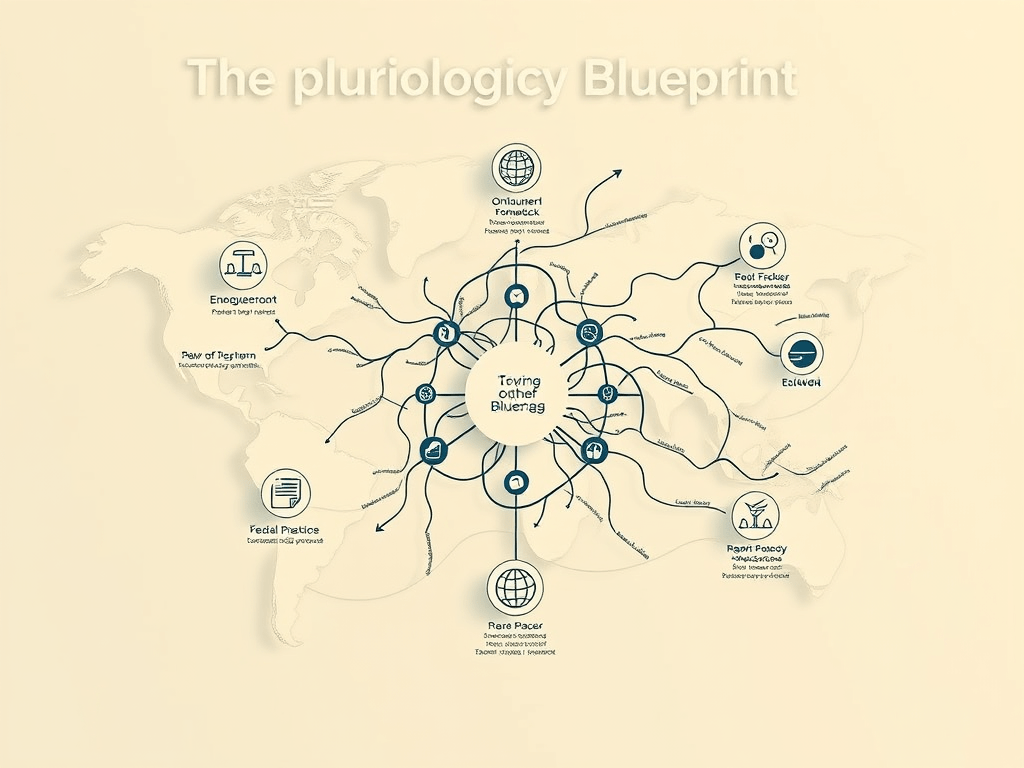
1. The Realm of Cartography
This realm contains:
- coherence landscapes
- mode maps
- field diagrams
- disturbance charts
- constraint maps
- repair pathways
- ecosystem diagrams
- blueprint expansions
This is the visual intelligence of the discipline.
2. The Realm of Narrative
This realm contains:
- case stories
- field stories
- mythic stories
- practitioner journals
- lineage stories
- community histories
This is the story intelligence of the discipline.
3. The Realm of Research
This realm contains:
- empirical studies
- field observations
- relational analytics
- mode transition data
- collective rhythm research
- ecological and cultural analyses
This is the scientific intelligence of the discipline.
4. The Realm of Practice
This realm contains:
- session transcripts
- practitioner reflections
- classroom notes
- ritual scripts
- community practices
- applied frameworks
This is the practical intelligence of the discipline.
5. The Realm of Creation
This realm contains:
- poems
- songs
- visual art
- movement practices
- aesthetic experiments
- symbolic works
This is the creative intelligence of the discipline.
III. The Library’s Internal Architecture — The Four Shelves
#LibraryShelves #StructuralDesign
Each realm is organized into four “shelves,” representing different levels of refinement.
Shelf 1 — Raw Material
Unfiltered notes, early maps, field observations, drafts.
Shelf 2 — Working Documents
Refined but not finalized writings, maps, and frameworks.
Shelf 3 — Polished Works
Completed essays, diagrams, stories, and research.
Shelf 4 — Canon‑Adjacent Works
Texts that approach canonical clarity but remain outside the core.
This structure keeps the Library alive and evolving.
IV. The Library as a Living Ecosystem
#LivingLibrary #KnowledgeEcology
The Library grows through:
- practitioner contributions
- community gatherings
- research cycles
- creative outputs
- lineage transmissions
- field sensing
It contracts through:
- rhythmic review
- coherence checks
- ethical alignment
- removal of distorted or incoherent works
The Library breathes like the Pluriome itself.
V. The Library’s Governance — Stewardship, Not Curation
#LibraryStewardship #RelationalCustody
The Library is not curated by gatekeepers.
It is stewarded by:
- the Cartography Guild
- the Narrative Guild
- the Research Guild
- the Practice Guild
- the Creative Guild
Each guild ensures:
- coherence
- ethical alignment
- relational integrity
- accessibility
- lineage continuity
The Library is a collective stewardship object.
VI. The Library’s Access Model — Open, Rhythmic, Relational
#LibraryAccess #OpenField
Access to the Library follows three principles:
1. Openness
Knowledge is shared, not hoarded.
2. Rhythm
Some works are accessible only during certain phases of the cycle.
3. Relation
Access deepens through participation, not hierarchy.
The Library is a commons, not a vault.
VII. The Library’s Role in the Discipline
#LibraryFunction #ExtendedCoherence
The Library:
- expands the Canon
- supports practitioners
- anchors pedagogy
- informs research
- preserves lineage memory
- houses cultural expression
- provides raw material for future evolution
- stabilizes the discipline’s extended coherence
It is the outer field of Pluriology’s knowledge ecosystem.
VIII. Why the Pluriological Library Matters
#LibrarySignificance #LivingLineage
The Library matters because it:
- keeps the discipline plural
- honors the many‑in‑relation
- preserves the richness of lived experience
- supports creativity and experimentation
- ensures the field remains adaptive
- provides a home for the discipline’s full expression
It is the living archive of Pluriology — the place where the discipline breathes, grows, and remembers.

























 Survivor Literacy
What do you think?