
Pluriology
The Pluriological Constitution — Governance, Rights, and Responsibilities of a Living Discipline
#PluriologicalConstitution #FieldGovernance #LineageStructure #ManyInRelation
Every lineage that survives more than a generation eventually develops a constitution — not a legal document, but a relational covenant that defines how the field governs itself, protects its coherence, and distributes responsibility across its stewards. The Pluriological Constitution is not hierarchical, bureaucratic, or punitive. It is a rhythmic governance system, a relational architecture that ensures the discipline remains coherent, ethical, and alive as it grows.
This chapter outlines the constitutional structure of Pluriology: the rights of practitioners and students, the responsibilities of stewards, the governance of the field, and the mechanisms that protect the discipline from fragmentation, distortion, or misuse.
I. The Purpose of the Pluriological Constitution
#ConstitutionPurpose #RelationalCovenant
The Constitution exists to:
- protect the ontology
- uphold the ethics
- maintain rhythmic integrity
- prevent hierarchy and coercion
- ensure lineage continuity
- distribute stewardship
- guide institutional evolution
- preserve the discipline’s coherence across generations
It is the relational backbone of Pluriology.
II. The Foundational Principles — The Constitution’s Core
#FoundationalPrinciples #DisciplinaryGround
The Constitution rests on five foundational principles:
1. The Field Is Primary
All governance decisions must protect the Pluriome.
2. Rhythm Governs Process
Timing, pacing, and mode sequencing override urgency or efficiency.
3. Multiplicity Is a Right
No practitioner or student may be forced into singularity.
4. Stewardship Over Authority
Leadership is relational, not hierarchical.
5. Ethics Are Non‑Negotiable
Non‑pathology, non‑interference, multiplicity honor, rhythmic integrity, and ecological compassion are binding.
These principles form the constitutional spine.
III. Rights Within the Discipline
#Rights #RelationalProtections
The Constitution guarantees specific rights to all members of the Pluriological ecosystem.
1. The Right to Multiplicity
Every person has the right to be many‑in‑relation without being pathologized.
2. The Right to Rhythmic Integrity
No one may be forced into Output, Connection, or Reconfiguration before their system is ready.
3. The Right to Non‑Interference
Practitioners, teachers, and institutions must not coerce transitions.
4. The Right to Field Safety
Members have the right to learn, practice, and create in environments that honor relational ecology.
5. The Right to Contextualization
No experience may be interpreted without considering field pressures and constraints.
These rights protect the inner ecology of every member.
IV. Responsibilities Within the Discipline
#Responsibilities #StewardshipDuties
With rights come responsibilities — not obligations, but relational commitments.
1. The Responsibility to Protect Coherence
Members must act in ways that stabilize, not fragment, the field.
2. The Responsibility to Honor Timing
Members must respect the rhythms of others and the collective.
3. The Responsibility to Uphold Ethics
Ethical integrity is the foundation of all practice.
4. The Responsibility to Maintain Lineage Clarity
Members must transmit the discipline faithfully, without distortion.
5. The Responsibility to Engage in Repair
When mismatch occurs, members participate in repair cascades with humility.
These responsibilities sustain the collective ecology.
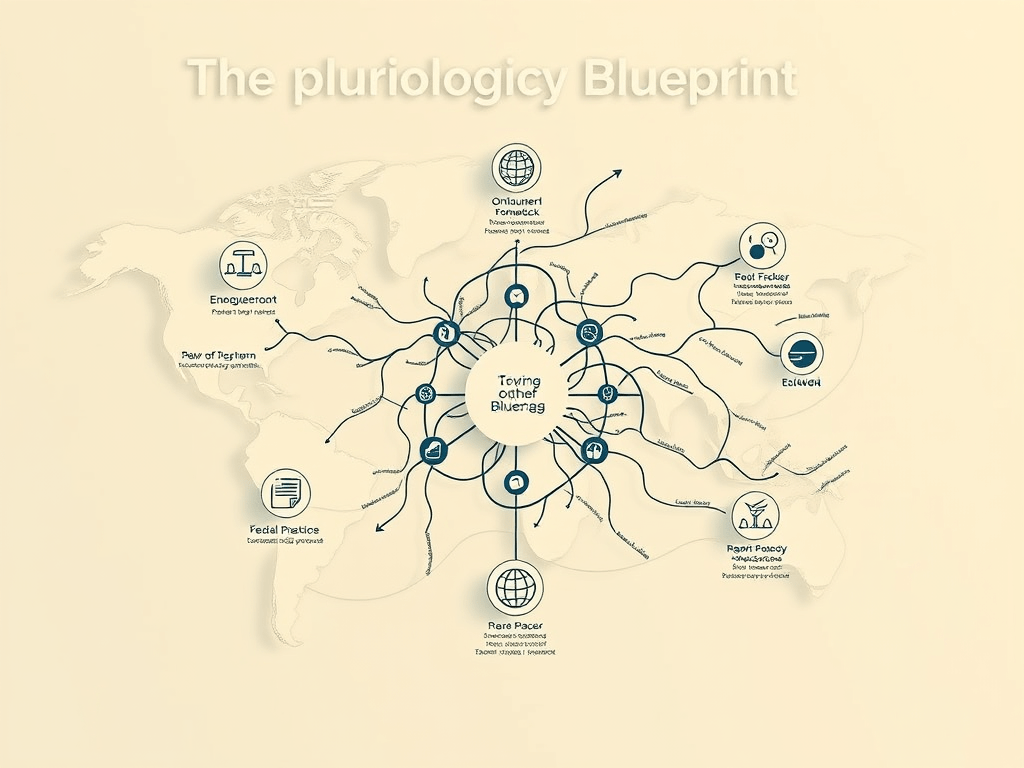
V. The Governance Structure — How the Field Organizes Itself
#Governance #RelationalStructure
Pluriology rejects hierarchy.
Its governance is rhythmic, relational, and distributed.
1. The Circle of Stewards
A rotating group of experienced practitioners who:
- protect the ontology
- uphold ethics
- guide institutional evolution
- sense the field’s collective rhythm
They do not rule.
They steward.
2. The Guilds
Domain‑specific groups that develop:
- pedagogy
- research
- creative applications
- organizational practice
- community coherence
Guilds are autonomous but aligned.
3. The Commons
An open space where:
- tools
- maps
- research
- stories
- practices
are shared freely.
The Commons is the heart of the lineage.
4. The Institute
The academic and research anchor that:
- trains practitioners
- maintains the curriculum
- develops the lexicon
- safeguards the discipline’s intellectual integrity
The Institute is not an authority — it is a custodian.
VI. The Constitutional Processes — How the Discipline Evolves
#EvolutionProcesses #AdaptiveGovernance
The Constitution defines processes for evolution.
1. Rhythmic Review
Every cycle (usually annually), the community assesses:
- the field’s contraction or expansion
- collective disturbances
- lineage coherence
This prevents drift.
2. Lexicon Stewardship
New terms must:
- align with ontology
- respect ethics
- integrate with existing architecture
Language evolves slowly and deliberately.
3. Pedagogical Calibration
Teaching methods are reviewed to ensure:
- rhythm alignment
- relational safety
- multiplicity honor
Pedagogy evolves with the field.
4. Lineage Transmission
New stewards are recognized through:
- demonstrated coherence
- ethical integrity
- field literacy
- relational maturity
Not through rank or seniority.
VII. The Constitutional Safeguards — Protecting the Discipline
#Safeguards #FieldProtection
The Constitution includes safeguards against distortion.
1. Anti‑Hierarchy Clause
No individual may claim authority over the field.
2. Anti‑Pathology Clause
No Pluriological concept may be used to diagnose or diminish.
3. Anti‑Extraction Clause
The discipline may not be used for coercive or exploitative purposes.
4. Anti‑Distortion Clause
Practitioners must not alter core ontology or ethics without collective review.
These safeguards preserve disciplinary integrity.
VIII. The Constitutional Ritual — Renewal Through Rhythm
#ConstitutionRitual #LineageRenewal
Once per cycle, the community performs a ritual of renewal:
- sensing the field
- naming the year’s rhythms
- acknowledging disturbances
- celebrating repair
- reaffirming the ethics
- renewing stewardship vows
This ritual keeps the Constitution alive, not static.
IX. Why the Pluriological Constitution Matters
#ConstitutionPurpose #LineageContinuity
The Constitution:
- protects the discipline from fragmentation
- ensures ethical integrity
- distributes stewardship
- anchors lineage continuity
- maintains coherence as the field grows
- provides a relational governance model
- keeps the discipline aligned with its ontology
It is the governing rhythm of Pluriology.



























 Survivor Literacy
What do you think?