Pluriology
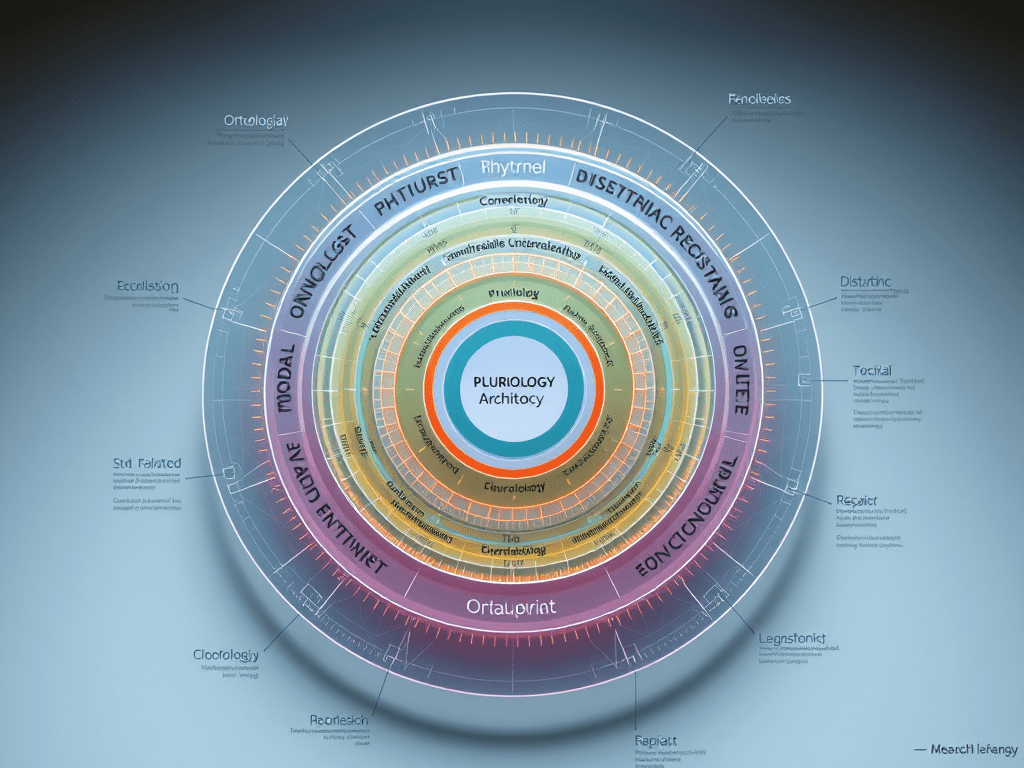
The Pluriological Blueprint — The Entire Discipline in One Coherent Architecture
#PluriologicalBlueprint #UnifiedField #DisciplinaryArchitecture #ManyInRelation
Every mature discipline eventually produces a blueprint — a single, elegant architecture that shows how all its components interlock. Not a summary, not a simplification, but a structural map of the discipline’s ontology, method, ethics, applications, and research agenda. A blueprint is how a field recognizes itself. It is how it becomes transmissible, teachable, and expandable.
Pluriology is uniquely suited to a blueprint because it is already an ecological system. Its concepts are not isolated; they are rhythmic, relational, and mutually reinforcing. The Pluriological Blueprint reveals the discipline as a closed‑loop architecture of coherence — a system that explains how human experience moves, breaks, restores, and relates within the Pluriome.
This chapter presents the full architecture of Pluriology in one coherent structure.
I. The Ontological Layer — What Exists in Pluriology
#Ontology #RelationalBeing
Pluriology rests on three ontological pillars:
1. The Plurallile Self
A multi‑voiced, multi‑modal, relationally embedded system.
2. The Pluriome
The relational medium — the ecosystem of rhythms, pressures, and currents.
3. The Pluriogenic Cycle
The rhythmic sequence of modes through which coherence emerges.
These three define the “what” of the discipline.
II. The Modal Layer — How Systems Move
#Modes #RelationalPostures
The Pluriogenic Modes are the metabolic engine of coherence:
- Perception — widening
- Reconfiguration — sinking
- Connection — reaching
- Output — expressing
Modes are not emotions or behaviors.
They are relational postures.
III. The Rhythmic Layer — How Time Behaves
#TemporalEcology #RhythmicIntelligence
Human systems move through rhythmic phases:
- Contraction
- Anchor
- Stabilization Wave
- Crest
- Reset
Rhythm is the temporal architecture of the discipline.
IV. The Disturbance Layer — How Coherence Breaks
#DisturbanceFramework #FrequencyMismatch
Disturbances arise when a mode transition is blocked:
- Overrider
- Submerged
- Stabilizer
- Scatterfield
- Overloaded
- Fragmented Map
Disturbances are adaptive, not pathological.
V. The Constraint Layer — Why Transitions Block
#SurvivalConstraints #EcologicalPressures
Blocks arise from:
- relational obligations
- cultural scripts
- economic pressures
- environmental stressors
- safety needs
Constraints are ecological, not personal.
VI. The Repair Layer — How Coherence Restores Itself
#RepairCascade #RestorationEcology
The Repair Cascade is the natural sequence of restoration:
- agitation → Perception
- heaviness → Reconfiguration
- rigidity → Connection
- fragmentation → Output
- overload → downshift
- discontinuity → integration
Repair is not intervention.
Repair is completion.
VII. The Field Layer — How Context Shapes Experience
#PluriomeLayers #RelationalEcology
The Pluriome has four layers:
- Microfield — immediate relational space
- Mesofield — social environment
- Macrofield — cultural narratives
- Surround — ecological and collective rhythms
The field is not background.
It is co‑author.
VIII. The Method Layer — How Pluriologists Practice
#PluriologicalMethod #Attunement
Pluriologists use four primary tools:
- Mode Tracking
- Rhythm Reading
- Field Sensing
- Constraint Identification
The method is attunement, not interpretation.
IX. The Cartographic Layer — How Systems Are Mapped
#PluriologicalCartography #TemporalMapping
Pluriological Cartography includes:
- rhythmic maps
- modal timelines
- disturbance signatures
- field dynamics
- coherence landscapes
Mapping makes the discipline visible.
X. The Ethical Layer — How Pluriologists Relate
#EthicOfCoherence #RelationalIntegrity
Pluriology is grounded in:
- non‑pathology
- relational stewardship
- multiplicity honor
- rhythmic integrity
- ecological compassion
- non‑interference
Ethics protect the discipline’s coherence.
XI. The Application Layer — How Pluriology Enters Life
#AppliedPluriology #RealWorldEcology
Pluriology reframes:
- creativity
- work
- relationships
- identity
- collective behavior
It becomes a practical literacy for navigating the Pluriome.
XII. The Research Layer — How the Discipline Evolves
#ResearchAgenda #FutureKnowledge
Pluriology investigates:
- modal dynamics
- rhythmic ecology
- field dynamics
- disturbance science
- repair cascades
- cartographic tools
- applied coherence
Research expands the discipline’s precision.
XIII. The Institutional Layer — How the Discipline Anchors Itself
#PluriologicalInstitute #DisciplinaryHome
The Pluriological Institute anchors:
- training
- research
- ethics
- stewardship
- cultural transmission
It is the home of the discipline.
XIV. The Cultural Layer — How Pluriology Changes the World
#RelationalFuture #CoherenceCentury
Pluriology reshapes:
- how people understand themselves
- how communities organize
- how organizations function
- how societies navigate turbulence
- how identity evolves
- how coherence is restored
It becomes the relational literacy of the future.
XV. The Blueprint as a Whole — A Closed‑Loop Architecture of Coherence
#UnifiedDiscipline #ManyInRelation
The Pluriological Blueprint reveals the discipline as a single, coherent system:
- Ontology defines what exists
- Modes define how systems move
- Rhythm defines when they move
- Disturbance defines how coherence breaks
- Repair defines how coherence returns
- Field defines where movement happens
- Method defines how movement is read
- Cartography defines how movement is mapped
- Ethics define how movement is witnessed
- Application defines how movement is used
- Research defines how movement is understood
- Institutions define how movement is preserved
- Culture defines how movement is lived
Pluriology is not a theory.
It is a relational architecture — a complete system for understanding the many‑in‑relation.



























 Survivor Literacy
What do you think?