Pluriology
Pluriological Cartography — Mapping Rhythms, Modes, and Disturbances Across Time
#PluriologicalCartography #RhythmMapping #TemporalEcology #Pluriology
Pluriology becomes powerful when it becomes visible. Not metaphorically visible — mapped. Pluriological Cartography is the discipline’s method for charting how a plurallile system moves through time: its rhythms, its mode transitions, its disturbances, its repair cascades, and its relationship with the Pluriome. This is not a diagnostic timeline. It is a temporal ecology — a living map of coherence and mismatch.
A Pluriological map is not a graph of symptoms or behaviors. It is a rhythmic landscape. It shows where the system contracted, where it reorganized, where it reached, where it expressed, where it was blocked, and where it restored itself. It reveals the geometry of a person’s relational life — the pulse of the many‑in‑relation.
This chapter introduces the foundations of Pluriological Cartography: how to map rhythms, how to track modes, how to identify disturbances, and how to visualize coherence across time.
The Purpose of Pluriological Cartography
#TemporalMapping #CoherenceOverTime
Pluriological Cartography answers a single question:
How does this system move through time?
Not:
- “What happened?”
- “Why did it happen?”
- “What does it mean?”
But:
- “What was the rhythm?”
- “What mode was active?”
- “What transition was blocked?”
- “What field pressure was present?”
- “What repair cascade followed?”
A Pluriological map reveals the shape of a person’s relational ecology.
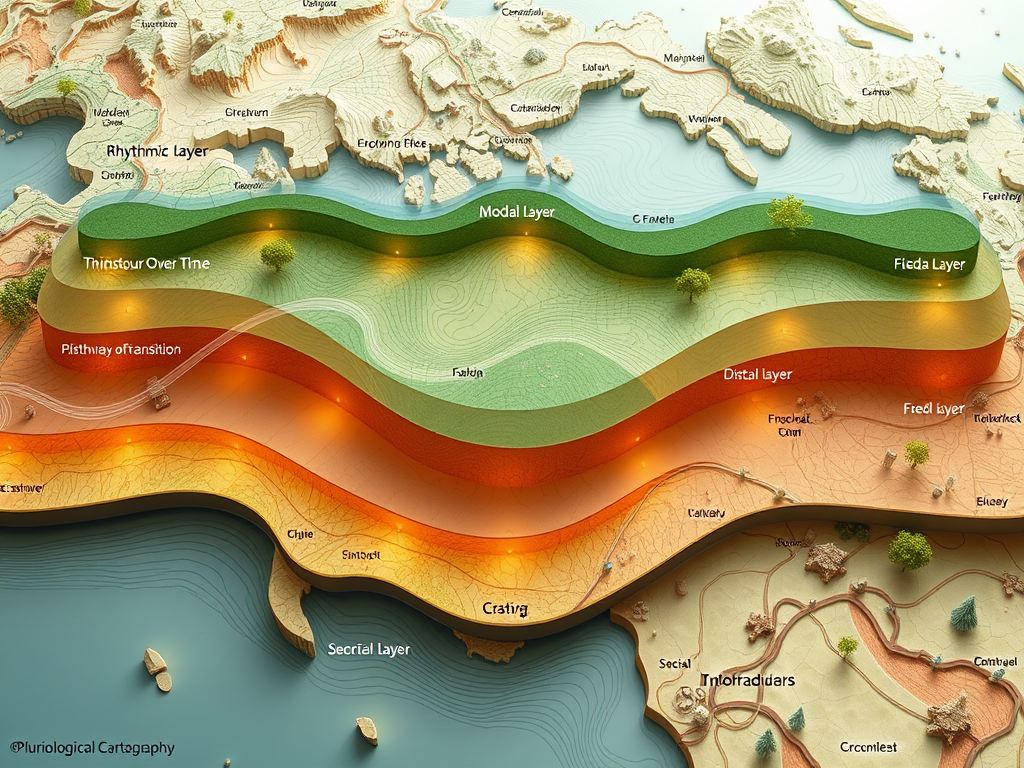
The Four Layers of a Pluriological Map
#LayeredMapping #RelationalTime
A complete Pluriological map has four layers:
1. The Rhythmic Layer — The Pulse Over Time
This layer tracks contraction, stabilization, crest, and reset.
It shows the tempo of the system.
2. The Modal Layer — The Mode Sequence
This layer tracks Perception, Reconfiguration, Connection, Output.
It shows the mode transitions.
3. The Disturbance Layer — The Blocks and Mismatches
This layer marks Overrider, Submerged, Stabilizer, Scatterfield, Overloaded, Fragmented Map.
It shows the frequency distortions.
4. The Field Layer — The Pluriome’s Movements
This layer tracks relational, social, cultural, and ecological pressures.
It shows the contextual currents.
Together, these layers form a temporal ecology — a map of the system’s movement through the Pluriome.
How Pluriologists Map Rhythms
#RhythmTracking #TemporalPulse
Rhythm is the backbone of Pluriological Cartography. A Pluriologist tracks:
- speed (fast, slow, oscillating)
- direction (contracting, expanding)
- intensity (subtle, sharp, overwhelming)
- continuity (smooth, interrupted, jagged)
Rhythms reveal:
- when a mode shift began
- when it was blocked
- when the system compensated
- when the repair cascade started
Rhythm is the most honest data a system produces.
How Pluriologists Map Modes
#ModeMapping #RelationalPostures
Modes are mapped as postures in time:
- Perception → widening
- Reconfiguration → sinking
- Connection → reaching
- Output → focusing
A Pluriologist marks:
- the entry into a mode
- the duration of the mode
- the attempted transition
- the interruption
- the fallback or compensation
This creates a modal timeline — a visual representation of the system’s relational metabolism.
How Pluriologists Map Disturbances
#DisturbanceMapping #FrequencyMismatch
Disturbances are mapped as blocks in the modal timeline. Each disturbance has a signature:
- Overrider → agitation spike
- Submerged → downward drag
- Stabilizer → rigid plateau
- Scatterfield → fragmented oscillation
- Overloaded → bandwidth collapse
- Fragmented Map → discontinuity
These signatures appear as distortions in the rhythmic and modal layers.
A Pluriologist marks:
- the moment the block occurred
- the survival constraint involved
- the resulting distortion
- the duration of the mismatch
This reveals the shape of the disturbance.
How Pluriologists Map the Field
#FieldMapping #PluriomeCurrents
The field layer tracks:
- relational currents
- environmental pressures
- cultural scripts
- social rhythms
- ecological cycles
A Pluriologist marks:
- when the field contracted
- when it opened
- when it surged
- when it destabilized
- when it demanded performance
- when it supported rest
This layer explains why the mode transition was blocked.
The Pluriological Map as a Whole
#TemporalEcology #CoherenceLandscape
When all four layers are combined, the map reveals:
- the system’s natural rhythm
- the system’s adaptive strategies
- the points of coherence
- the points of mismatch
- the timing of disturbances
- the timing of repair
- the relational pressures shaping the cycle
It becomes a coherence landscape — a visual representation of the plurallile self moving through the Pluriome.
Why Pluriological Cartography Matters
#RelationalInsight #NewLiteracy
Pluriological Cartography offers insights no other discipline can provide:
- It shows that disturbances are rhythmic, not pathological.
- It reveals that coherence is relational, not internal.
- It demonstrates that healing is cyclical, not linear.
- It makes visible the interplay between modes and field.
- It honors the plurallile nature of human experience.
It is the first mapping system designed for a world where human experience is distributed, dynamic, and relational.






























 Survivor Literacy
What do you think?