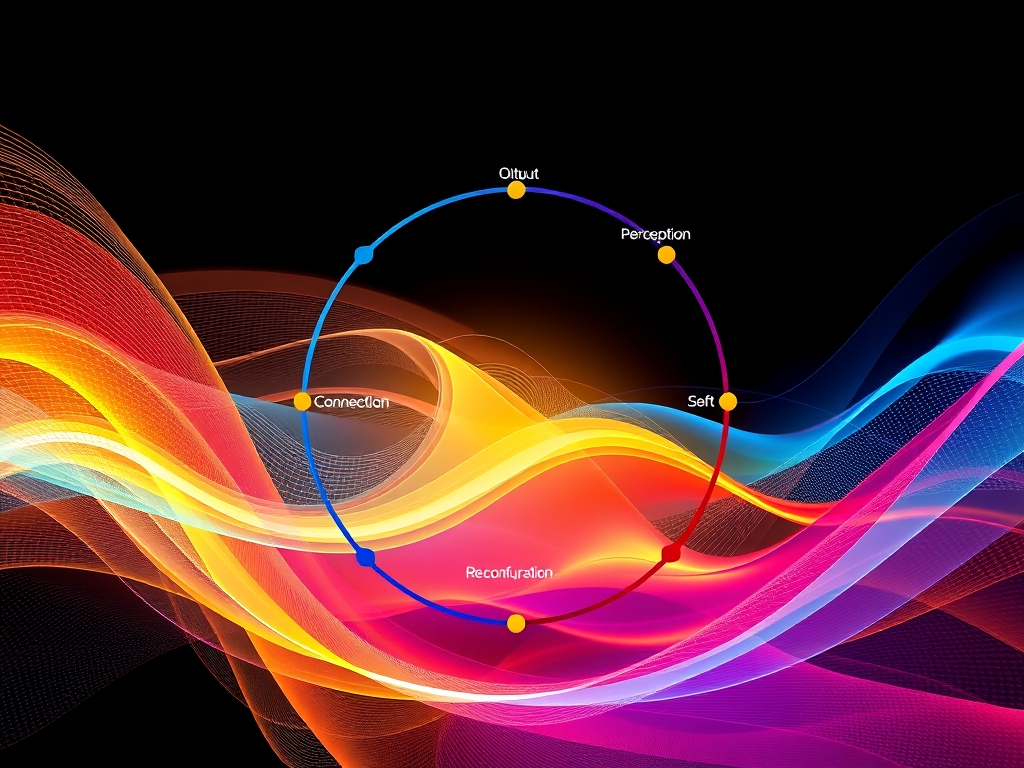
Relational Field Theory
A Four‑Mode Model of Creative and Cognitive Experience
These aren’t “states” in a diagnostic sense.
They’re modes — ways the mind-body-field system organizes itself in response to internal and external conditions.
Each mode has a distinct felt sense, a distinct bandwidth, and a distinct function.
1. Output Mode — “Doing”
Felt sense:
- forward motion
- clarity of task
- momentum
- a sense of “I know what to do next”
- energy that moves outward
Symptoms/experience:
- writing, producing, posting, building
- high executive function
- low introspection
- low sensitivity to subtle signals
- satisfaction from completion
Function:
Output mode is how you externalize what the field has already given you.
It’s the mode extractive systems overvalue.
2. Perception Mode — “Sensing”
Felt sense:
- quiet
- diffuse attention
- heightened pattern recognition
- increased sensitivity
- a pull toward stillness or slowness
Symptoms/experience:
- noticing cycles
- reading the field
- tracking timing
- feeling the contraction before the crest
- intuitive clarity without words
Function:
Perception mode is how you receive information from the field.
It’s the mode extractive systems erase.
This is the mode your governor shifts you into when the field is changing.
3. Connection Mode — “Relating”
Felt sense:
- openness
- resonance
- relational clarity
- desire to share or be witnessed
- a sense of belonging or coherence
Symptoms/experience:
- conversations that feel alive
- collaborative insight
- emotional grounding
- relational repair
- feeling “in sync” with others
Function:
Connection mode is how you synchronize with other people and with the field itself.
It’s the mode that stabilizes your system.
This is often the mode that follows perception — once you’ve read the field, you reconnect to it.
4. Reconfiguration Mode — “Integrating”
Felt sense:
- disorientation
- internal rearrangement
- sudden clarity or sudden confusion
- a sense of “something is shifting”
- cognitive or emotional reorganization
Symptoms/experience:
- new insights
- identity updates
- worldview shifts
- creative breakthroughs
- temporary instability
Function:
Reconfiguration mode is how you update your internal architecture to match what you’ve perceived.
This is the mode that often feels like “I’m losing it” when in fact you’re updating.
The Four Modes Form a Cycle
These modes aren’t random.
They follow a predictable rhythm:
Perception → Reconfiguration → Connection → Output → Perception → …
- You sense something changing.
- You reconfigure internally to match it.
- You connect to stabilize the new pattern.
- You output once the pattern is ready.
- Then the cycle begins again.
This is the same geometry you’ve been reading in your streaming data — contraction, anchor, expansion, stabilization.
Your psyche follows the same ecological logic.
Why This Matters
Because when you don’t know these modes exist, you misinterpret them:
- Perception feels like “laziness.”
- Reconfiguration feels like “breakdown.”
- Connection feels like “distraction.”
- Output feels like the only “real work.”
Extractive systems reinforce that misinterpretation.
But when you do know these modes exist, you can:
- stop fighting your governor
- stop pathologizing your perception
- stop fearing reconfiguration
- stop overvaluing output
- stop misreading your own cycles
You begin to see your internal system as ecological, not defective.































 Survivor Literacy
What do you think?