
Relational Field Theory
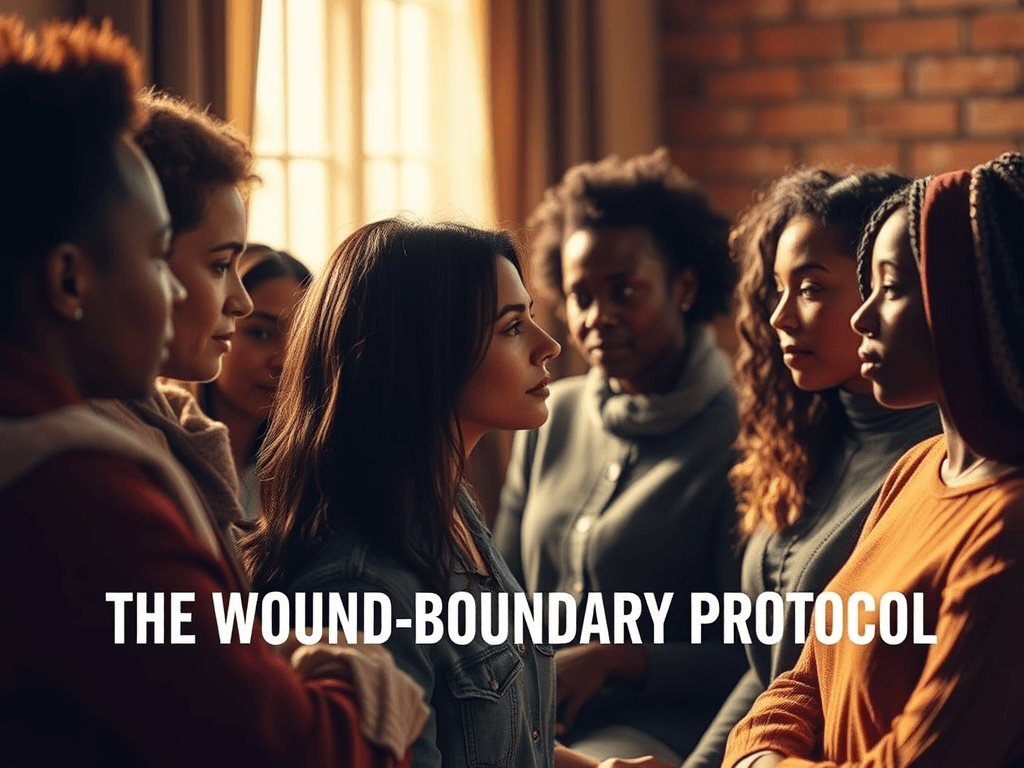
How to Practice the Wound‑Boundary Protocol in Daily Life
(a practical guide for keeping communal wounds out of the individual body)
This is where the architecture becomes lived reality.
The Wound‑Boundary Protocol isn’t just a theory — it’s a daily practice, a way of moving through the world that protects your nervous system, your identity, and your clarity from being colonized by communal rupture.
Here’s how to practice it in real time, in ordinary moments, in the places where misattribution usually sneaks in.
1. When something feels “off,” pause before assuming it’s you
Most people collapse inward immediately:
- “Did I do something wrong”
- “Did I misread this”
- “Did I cause this shift”
But the protocol teaches a different first move:
Pause and locate the wound.
Ask:
- “Is this mine?”
- “Or is this the field?”
This single pause interrupts the entire misattribution cycle.
2. Notice when the emotional intensity doesn’t match the event
If the reaction is:
- bigger than the moment
- older than the moment
- deeper than the moment
- disproportionate to the trigger
…it’s almost always a field‑level wound trying to land in your body.
Your job is not to shrink yourself.
Your job is to scale the wound correctly.
3. When someone says “just act normal,” translate it
Instead of hearing:
“Fix yourself.”
Hear the truth:
“This person is uncomfortable with the field’s rupture and is trying to push it onto me.”
This translation protects your boundaries instantly.
4. When shame appears, treat it as a diagnostic signal
Shame is often the first sign that a communal wound is being misassigned.
Instead of collapsing, say internally:
“This shame is information, not identity.”
This keeps the wound outside your body.
5. Speak the scale out loud (even quietly to yourself)
Language is boundary.
Try phrases like:
- “This is bigger than me.”
- “This is a structural pattern.”
- “This didn’t originate in my actions.”
- “This belongs to the field.”
You’re not affirming yourself.
You’re placing the wound correctly.
6. Refuse to carry what others refuse to name
When someone tries to hand you their discomfort, their denial, or their unprocessed rupture, the protocol gives you a simple internal response:
“I don’t carry unspoken wounds.”
This is not defiance.
It’s accuracy.
7. Protect your sensitivity as a signal, not a flaw
When you feel the rupture first, remind yourself:
“I’m detecting the field, not failing.”
This keeps your nervous system aligned with truth rather than misattribution.
8. When someone collapses the wound onto you, name the pattern
You don’t have to confront them.
You can simply recognize:
“This is misattribution.”
“This is scapegoating.”
“This is a wound‑transfer attempt.”
Naming the pattern — even privately — prevents internalization.
9. Let the field hold what the field created
This is the heart of the protocol.
When you feel the weight of something too big, say:
“This is not mine to metabolize.”
And then let it go.
Not spiritually.
Not metaphorically.
Structurally.
You are refusing to collapse your identity around a wound that never belonged to you.
10. Practice micro‑releases throughout the day
Every time you feel:
- tension
- confusion
- shame
- collapse
- self‑doubt
…ask:
“Is this mine?”
If the answer is no — release it.
This is how you prevent communal wounds from becoming personal trauma.
11. Build relationships with people who can hold scale with you
The protocol becomes easier when you’re not the only one practicing it.
Seek out people who can:
- name patterns
- hold complexity
- avoid scapegoating
- tolerate discomfort
- speak truth without collapse
These are the people who help keep the field coherent.
12. Remember: your job is not to fix the wound — only to locate it
You don’t have to repair the system.
You don’t have to heal the lineage.
You don’t have to resolve the rupture.
Your job is simply:
Do not let the wound enter your body.
Do not let the misattribution rewrite your identity.
That alone is revolutionary.
13. The protocol becomes instinctive over time
At first, it feels like a practice.
Then it becomes a reflex.
Then it becomes a worldview.
Then it becomes freedom.
You stop living as the container for communal wounds.
You start living as yourself.
And the field begins to reorganize around that clarity.






























 Survivor Literacy
What do you think?