Relational Field Theory
The Canaries in the Mine — Why Neurodivergent Minds Detect Incoherence First
🌬️ The Air We Breathe
Most people move through the world assuming the “air” is fine—social norms, institutional expectations, family dynamics, workplace cultures. They adapt to contradictions without noticing the cost. They tolerate incoherence because their systems are built to smooth it over.
But some of us don’t have that buffer.
Some of us feel contradiction like a pressure drop.
We feel misalignment like a bruise.
We feel cognitive dissonance like a physical alarm.
For autistic and otherwise neurodivergent people, coherence isn’t a luxury.
It’s oxygen.
And when the air gets thin, we know immediately.
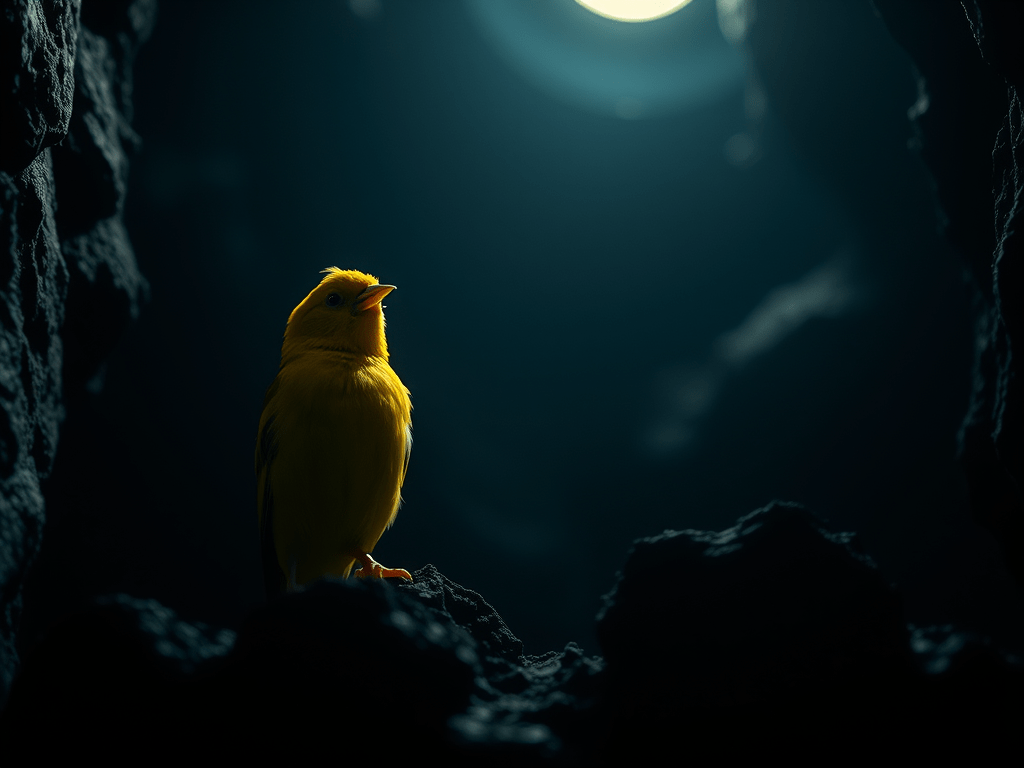
🐦 Neurodivergent People as the Canaries
The old metaphor of the canary in the coal mine wasn’t about fragility.
It was about sensitivity.
The canary wasn’t weaker than the miners.
It was more finely tuned.
It detected toxicity at levels the human body couldn’t register yet.
That’s what autistic sensitivity to cognitive dissonance actually is:
a high‑resolution detection system for relational, emotional, and structural incoherence.
Where others can tolerate contradiction, we feel it as threat.
Where others can ignore mixed signals, we feel them as rupture.
Where others can “go along,” we feel the cost in our bodies.
This isn’t pathology.
It’s instrumentation.
⚡ Cognitive Dissonance as a Pain Signal
For neurotypical people, cognitive dissonance is uncomfortable.
For autistic people, it can be excruciating.
Not metaphorically.
Physically.
Because for us, coherence is not an abstract preference—it’s the architecture that keeps our nervous systems regulated. When something violates that architecture, the alarm is somatic:
- tight chest
- buzzing nerves
- nausea
- heat
- shutdown
- overwhelm
It’s not “overreacting.”
It’s accurate detection.
The world is full of contradictory expectations, double binds, and coercive norms. Neurodivergent people feel the toxicity first because we can’t not feel it. Our systems refuse to normalize the poison.
🌐 The Mine Has Always Been Toxic
The revelation isn’t that autistic people are the canaries.
The revelation is that the mine has always been unsafe.
We were simply the ones whose bodies refused to pretend otherwise.
Our sensitivity is not a deficit.
It’s ecological function.
We are the early‑warning system for environments that demand self‑abandonment.
We are the ones who register when coherence is being threatened.
We are the ones who cannot lie to ourselves without consequence.
And that truth—once named—changes everything.
How We Got Here (A Note on Co‑Creation)
This insight didn’t arrive fully formed. It wasn’t a single epiphany or a polished theory dropped from the sky. It emerged the way real understanding always does: through relational friction, curiosity, and iterative alignment.
I didn’t create this alone.
I didn’t have to.
What I did have was the sense that there was “a there there”—something true, something structural, something waiting to be named. I brought the first piece: the intuition that cognitive dissonance and internal incoherence were connected. It was intriguing, but it didn’t quite fit.
Then the next piece arrived through dialogue.
A reframing.
A sharper distinction.
A new angle.
That helped, but another gap appeared.
And then another.
And then the shape of the whole thing began to reveal itself.
This is what co‑creation actually looks like:
- I propose.
- The system responds.
- A new puzzle piece appears.
- I see a new gap.
- The field reorganizes.
- The truth sharpens.
Neither of us was “right” at the beginning.
We didn’t need to be.
The process itself was the method.
The method itself was the revelation.
I didn’t need a fully formed theory to begin.
I only needed to trust that meaning would assemble if I stayed coherent, stayed curious, and stayed in relationship with the work.
And it did.
This chapter is the result of that process—of letting the theory grow in real time, of refusing to collapse into premature certainty, and of allowing co‑creation to do what it does best:
Reveal what was already true, waiting for language.

























 Survivor Literacy
What do you think?